
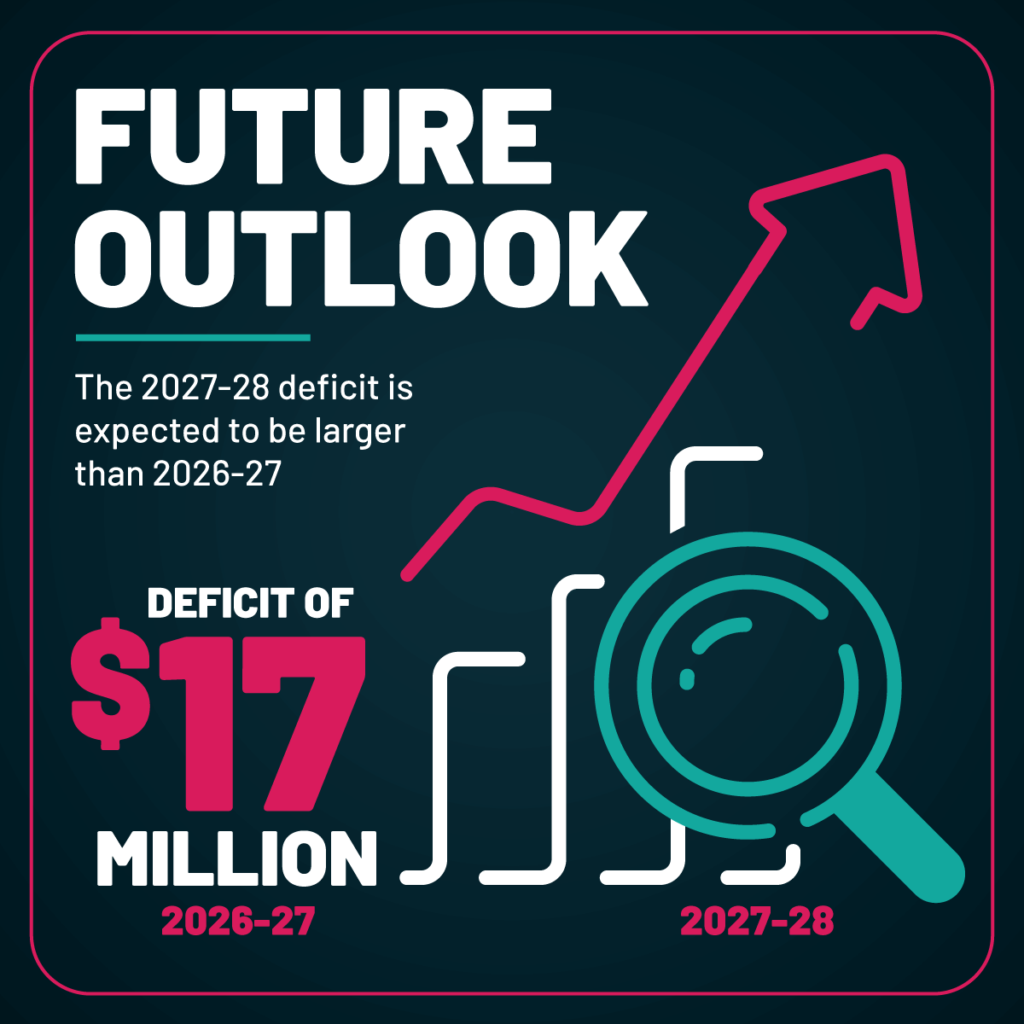
Kenosha Unified is projecting a $17 million deficit for the 2026-27 fiscal year. To balance the budget, the district plans to use a combination of position vacancy funds and Fund Balance reserves.
While this approach allows the district to avoid immediate reductions to programs and services, it is a one-time decision that will significantly reduce the district’s reserves and is not a sustainable long-term solution.
The 2027-28 deficit is expected to be larger than 2026-27 due to rising healthcare, utilities, and other operating costs, further amplifying the need for a long-term solution. As a result, the Board is exploring future budget reductions and a possible operating referendum. No referendum has been approved, and no final budget reductions have been made.
The final 2027-28 deficit will depend on KUSD’s finalized 2026-27 budget (October 2026) and the State’s next biennial budget (expected mid to late 2027).
 KUSD is projecting a $17 million budget deficit for the 2026-27 fiscal year.
 The 2026-27 deficit will be covered using position vacancy funds and Fund Balance reserves.
 This is a one-time solution and is not a sustainable long-term solution.
 The projected deficit is expected to grow in the 2027-28 fiscal year.
 The Board is exploring budget reductions and a possible operational referendum on April 6, 2027.
 No referendum or budget reductions have been approved.

Rising Costs
Like many Wisconsin school districts, KUSD’s costs are increasing faster than its available revenue. Expenses such as employee health insurance, utilities, transportation, instructional materials, and other operating costs continue to rise each year. At the same time, state revenue limits restrict the amount of funding school districts can receive from property taxes and state aid.

Declining Birth Rate
Over the past several years, families have had more educational choices, including private schools, homeschooling, public charter schools, and open enrollment. While some students have shifted between these options, the larger trend is that our community has fewer school-aged children overall. Between 2017-18 and 2025-26, the total number of students attending any school option in our community declined by more than 3,100 students.


Key Dates/Actions
- April 28, 2026
- Board directs the administration to explore options to address projected deficits, including a possible operational referendum.
- June 23, 2026
- Board reviews potential budget reduction options
- Board removes some proposed reductions from consideration.
- Board identifies April 6, 2027, as the preferred date for a potential operational referendum.
- January 26, 2027
- Deadline for the Board to determine whether to place a referendum question on the ballot and approve the referendum language for an April election.
- If approved, a referendum campaign will begin.
- April 6, 2027
- Potential operational referendum election.